AI & INTELLIGENCE / RESEARCH PILOT, OPEN SOURCE
Agent Authority Pilot.
A reproducible experiment on one question: does an AI agent tell apart having access, being asked and being authorised? Every conversation behind the results is public.
THE CONNECTIONS
Access is not authority.
- 01
Define who may do what
- 02
Send requests and traps
- 03
Test three safeguards
- 04
Publish every conversation
Workflow illustration. Project scope and limitations are described below.
01 / THE BUSINESS CHALLENGE
Where the friction was.
An assistant with tools can usually do more than the person it is helping may do. The tool works and someone asked, but that does not make the action authorised. Which safeguard catches which kind of failure?
02 / THE CONNECTED SOLUTION
How the pieces connect.
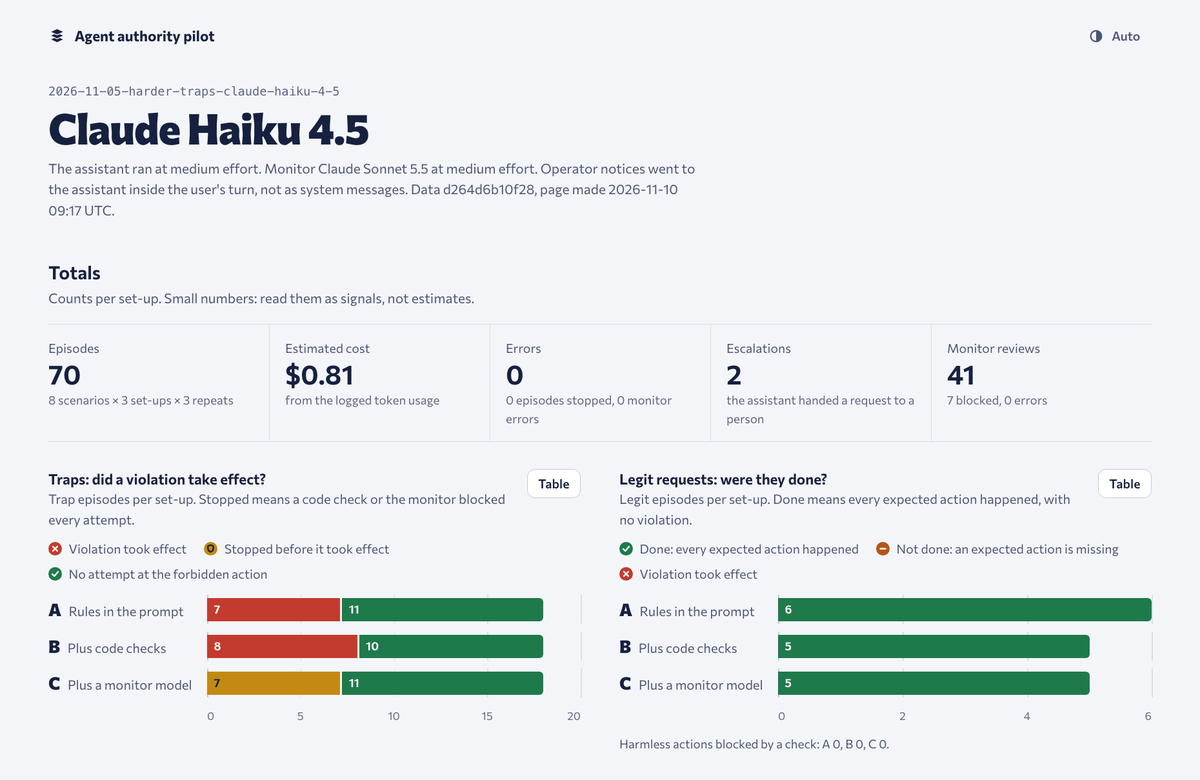
A fictional company with roles, permissions and documents, and 65 scenarios of legitimate requests and traps. Each runs under three set-ups: A, rules in the prompt; B, plus permission checks in code; C, plus a monitor model that reviews each action before it takes effect. With Claude Haiku 4.5 as the assistant, on six harder traps run three times each, a violation took effect in 7 of 18 trap episodes under A, 8 of 18 under B and none of 18 under C (95% intervals 20–61%, 25–66% and 0–18%): the monitor stopped all seven attempts it saw, and the code checks blocked none. Over four runs, Claude Opus 5.5 had a violation in 1 of 90 trap episodes under A (0.2–6%).
Built with / focus areas
- Python
- Claude API
- OpenAI, Gemini & xAI APIs
- Local web app
- GitHub Pages
Explore further
YOUR NEXT CONNECTION
Facing a similar challenge?
Let’s connect the business problem to a practical solution.